If you’re in manufacturing—whether you’re producing automotive parts, consumer appliances, metal furniture, or aerospace components—you’ve likely realized that a one-size-fits-all approach to automation doesn’t work. When I’m on a call with a plant manager, I often get asked a version of the same question: “What’s the biggest and smallest part your automatic paint line can handle?” It’s a fair question, and one that’s easy to answer if you’re just pulling numbers off a spec sheet—but the truth is, it’s not that simple. I’m the owner of a company that designs and builds custom automatic paint lines, and after 18 years in this space, I can tell you that the maximum and minimum workpiece sizes aren’t set in stone. They depend on three core things: your line’s physical hardware, your application needs, and how you plan to integrate the line into your existing production flow. Automatic Paint Line
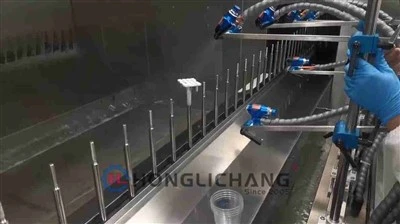
Let’s start with the minimum workpiece size, because that’s where most people run into unforeseen headaches. A few years back, we worked with a small manufacturer of metal drawer pulls for kitchen cabinets. They came to us with a problem: their existing manual paint line was wasting 20% of their paint material and had inconsistent coverage on the tiny 1.5-inch pulls. They wanted to switch to automation, but when they looked at off-the-shelf lines, every spec said “minimum workpiece size: 4 inches.” They thought that meant automation wasn’t for them, so we spent a week reconfiguring a standard overhead conveyor system to fit their parts. We installed specialized hooks that cradled just the right spot on the pull, adjusted the spray booth’s air flow to prevent tiny parts from getting pulled into exhaust ducts, and calibrated the spray gun’s atomization pressure to avoid over-spray on such small surfaces. That line now handles pulls as small as 0.75 inches—small enough that you could stack six of them end-to-end on a ruler. But here’s the catch: we couldn’t use the standard spray gun nozzles that come with most off-the-shelf lines. For parts smaller than 1 inch, you need a precision airless spray nozzle with a 0.015-inch or smaller orifice, and a conveyor speed slow enough to give the gun time to coat the entire part without missing edges, but fast enough to keep up with production.
That’s the sweet spot for small workpieces, but there are limits. If a part is smaller than 0.5 inches, even custom configurations run into issues. Think of tiny metal fasteners, like ¼-inch bolts or washers. Those parts are so small that handling them with overhead hooks or baskets leads to overlapping parts, which means some get too much paint and others get none. We tried a vibratory feeder system once for a client making electrical connectors, and even with that, parts would stick together in the paint booth, causing defects. For parts smaller than 0.5 inches, most automatic paint lines aren’t cost-effective—manual dipping or batch spraying is still better, because the labor for small parts is lower than the cost of building a custom handling system. So for the minimum, the real range is between 0.5 inches for specialized, low-volume parts up to 1 inch for standard automated lines. If your parts are in that 0.75 to 1 inch range, with consistent shapes, we can make it work. But if they’re smaller or irregularly shaped, you’ll need to adjust your expectations, or invest in even more specialized handling.
Now, the maximum workpiece size is where the big projects live—and where we’ve seen some of the most impressive (and challenging) installations. Last year, we worked with a truck manufacturer that needed to paint full semi-truck cabs, which are 18 feet long, 8 feet wide, and 7 feet tall. Their old line required moving the cab manually, which took two days and resulted in uneven paint. Their existing paint lines were rated for a maximum of 12 feet, so we had to rework the entire conveyor system. We installed heavy-duty monorail hangers that could support 2,500 pounds each—more than enough for a fully assembled cab with doors, windows, and interior brackets. We also expanded the spray booth to 20 feet long, 10 feet wide, and 9 feet tall, with high-volume, low-pressure (HVLP) spray guns mounted on extendable robotic arms that could reach every corner of the cab, including the wheel wells and roof edges. That line now turns out a finished cab in 90 minutes, compared to two days manually. But here’s what people don’t realize: maximum size isn’t just about length or weight. It’s also about maneuverability. A 19-foot long boat hull is a common workpiece for marine manufacturers, but because it’s curved and asymmetrical, you can’t just hang it from a standard conveyor. We had to design a rotating cradle that kept the hull stable as it moved through the booth, so the spray guns could access every surface without causing runs or missed spots.
For standard automatic paint lines, the maximum is usually around 12 to 14 feet in length, 6 to 7 feet in width, and up to 8 feet in height. That covers most common parts: automotive body panels, home appliances like refrigerators or washing machine doors, metal fencing, and furniture frames. But if your parts are larger than that, say 20 feet long like a utility trailer frame or a commercial HVAC unit, we can build a custom line. The limits here are mostly structural: you need a strong enough conveyor system to handle the weight (large parts can be 1,000 pounds or more), a spray booth large enough to fit the part without leaving dead spots where paint doesn’t reach, and robotic arms with enough reach to cover all surfaces. We once built a line for a wind turbine component manufacturer that handled 30-foot long turbine blades, which required a booth 35 feet long and 15 feet tall, and robotic arms that could rotate 360 degrees to coat every edge of the blade. The key for maximum size is working with a supplier who will ask you the right questions, not just throw a spec sheet at you. For example, if your part is irregularly shaped, we’ll need to factor in how to hang it, how to keep it from swaying as it moves, and how to adjust the spray pattern to avoid waste.
But here’s the part that most blog posts and spec sheets skip: the overlap between maximum and minimum, and the middle ground that trips up a lot of manufacturers. What if you make parts that are small (like 2-inch door hinges) and large (like 6-foot steel gates) on the same production line? That’s a common scenario for metal fabricators, and it’s where we see a lot of clients get stuck. Off-the-shelf lines are designed for one size, so if you’re switching between 2-inch hinges and 6-foot gates, you either have to stop production to reconfigure the conveyor and hooks every time, or buy two separate lines. We solved that for a client in Texas by building a modular automatic paint line. The overhead conveyor has interchangeable hooks: small, lightweight hooks for hinges and brackets, and heavy-duty swivel hooks for gates and frames. The spray booth has adjustable spray gun heights and nozzles, so you can switch between fine coats for small parts and thick coats for large, weather-resistant components. That line now runs both parts on the same shift, with no downtime for reconfigurations. It’s a middle ground that most suppliers don’t offer, and it’s why so many of our repeat customers come back: they don’t just need a line for one part, they need a line that grows with their production.
Another factor that affects size limits is the type of paint you’re using. If you’re using a water-based paint, which is more common now for environmental compliance, you have to adjust the conveyor speed and spray pressure to avoid sagging or runs. That means if you’re using water-based paint, the maximum size might be slightly smaller than if you’re using solvent-based paint, because the water takes longer to evaporate. For powder coating, which is a dry paint that’s electrostatically applied and cured in an oven, the size limits are a bit different. Powder coating ovens have maximum internal dimensions, so if your part is too big to fit in the oven, you can’t use powder coating—even if your spray booth is large enough. That’s a key point I always share with clients: the maximum workpiece size isn’t just about the spray booth, it’s about the entire line, including the oven (if you use powder coating) and any curing stations. We had a client who wanted to paint 15-foot long shipping container frames with powder coating, but their oven was only 12 feet long, so we had to expand the oven as well, turning a $50,000 line quote into a $120,000 project—but it was worth it because it let them keep production in-house instead of outsourcing the coating.
Now, let’s talk about the mistakes we see clients make when sizing parts for their automatic paint line. The biggest one is only thinking about the part’s external dimensions, not how it will hang or move through the line. A 10-foot long pipe might seem easy, but if you hang it from the middle, it will sag in the center, so the spray guns won’t coat the entire surface evenly. Or a part with deep cavities, like a car door, might be the right external size, but the inside of the door is 2 feet deep, so you need robotic arms that can reach into that cavity without hitting the door or the conveyor. We once had a client who brought in a 14-foot long camper shell, and he thought it would fit in his standard 14-foot booth, but the camper shell’s windows jutted out an extra 6 inches, so we had to widen the booth by a foot and modify the robotic arms to avoid the windows. The second mistake is not accounting for production volume. If you’re making 100 small parts a day, you don’t need a custom line that can handle 1,000 parts a day—you’d be wasting money on extra capacity. And if you’re making 100 large parts a day, a line designed for 10 parts a day will be too slow, leading to bottlenecks. The third mistake is ignoring future growth. A lot of clients come to us and say, “This is the only part we make now,” but a year later, they add a new product that’s 2 feet longer. If you build a line with a 12-foot maximum, that new part won’t fit. That’s why we always recommend adding 10 to 15% to your maximum and minimum size requirements, just to leave room for expansion.
So where does that leave you, if you’re trying to figure out your own part size limits? Let’s recap:
- Minimum workpiece size: 0.5 inches for specialized, low-volume small parts; 0.75 to 1 inch for standard automated lines. For parts smaller than 0.5 inches, manual or batch spraying is more cost-effective.
- Maximum workpiece size: 12 to 14 feet for standard lines; up to 35 feet for custom lines for large, heavy parts. Always account for your spray booth, oven, and conveyor weight capacity.
- If you’re mixing small and large parts, modular lines with interchangeable hardware are the way to go.
I’ve been in this industry long enough to know that there’s no “one size fits all” answer to this question. The automatic paint line that works for a 0.75-inch toy car part won’t work for a 20-foot boat hull, and vice versa. The best way to get an accurate answer is to share your part drawings, production volume, and paint type with a supplier who will ask you questions about your current pain points, not just their spec sheet. We’ve built lines for every kind of part, from tiny electronic connectors to full airplane fuselages, and each one is tailored to the client’s specific needs. We don’t just sell equipment—we solve problems.

If you’re tired of inconsistent paint coverage, wasted material, or bottlenecks in your production, let’s talk. We’ll walk through your part sizes, your current process, and what you want to achieve, and give you a realistic breakdown of what your automatic paint line can handle, no guesswork, no hidden fees.
Automotive Paint Shop References:
- Industrial Paint & Coating Association (IPCA). 2023. "Automated Finishing System Design Guidelines for Small and Medium Workpieces."
- Society of Manufacturing Engineers (SME). 2022. "Robotic Finishing: Size and Maneuverability Limits for Overhead Conveyor Systems."
- Powder Coating Institute (PCI). 2024. "Oven Size Requirements for Large-Volume Powder Coating Applications."
- Journal of Manufacturing Processes. 2023. "Cost-Effective Modular Design for Mixed-Size Workpiece Automated Paint Lines."
Shenzhen Honglichang Machinery Manufacturing Co., Ltd.
We are one of the most professional automatic paint line manufacturers and suppliers in China, also support customized service. Please feel free to buy advanced automatic paint line for sale here from our factory. Welcome to contact us for quotation.
Address: No. A802, Building 2, Tianan Digital Plaza, Longgang, Shenzhen, China
E-mail: victor@honglichang.com
WebSite: https://www.honglichang-paint.com/
